
How PNut works
Two ways to check a packet, four possible answers, and a short list of things PNut cannot do. This page is the honest version: read the limits as well as the features.
Two ways to scan
Barcode, or a photo of the label
Scan the barcode
Point the camera at the barcode on the pack. PNut looks the product up inOpen Food Facts, an open database of food products, and checks the ingredient list it gets back against the allergens you selected. It is the fastest route when the product is in the database.
If the barcode is not in the database, or the entry has no ingredient list, PNut says so and offers to scan the label instead. It does not fill the gap with a guess.
Photograph the label
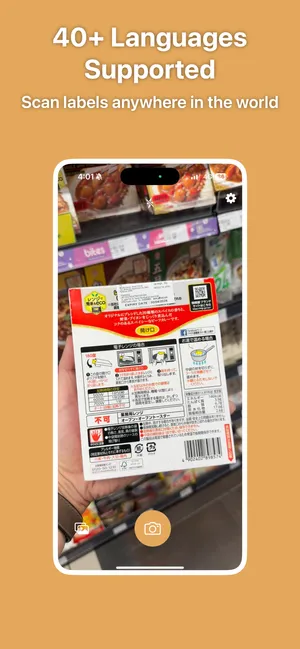
Take a photo of the ingredient panel and AI reads and analyses the text in 40+ languages, then explains the result in yours. This is the route for loose imports, regional products and anything the database has never seen.
Fill the frame with the ingredient list, in focus, with the whole paragraph inside the shot. A photo that cuts off half the list is the most common reason a scan comes backUnknown.
Your list
You decide what counts as an allergen
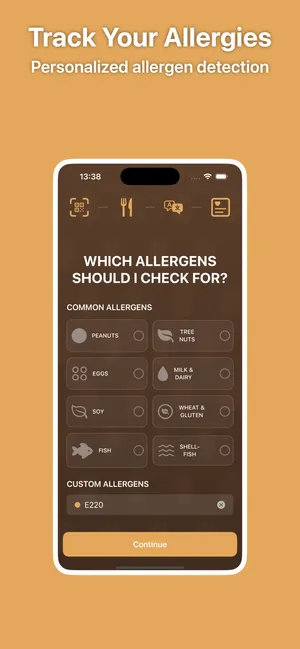
Before the first scan you choose which allergens matter: peanuts, tree nuts, eggs, milk, soy, wheat and gluten, fish, shellfish and sesame — and anything else you add yourself, down to a single additive such as E220. PNut flags only what is on your list, so a shellfish warning does not clutter a scan you ran for milk.
The allergen guides list the names that mean an allergen without saying it — casein for milk, semolina for wheat — which is what PNut is matching against.
Four possible answers
Every scan lands on one of four verdicts
Each one comes with the reasoning and the ingredient text PNut extracted, so you can check its working against the packet in your hand.
- Safe
None of your allergens appear in the ingredients.
- Contains allergen
An allergen you selected is listed in the ingredients.
- May contain
The label warns of traces or shared equipment.
- Unknown
The label could not be read or the ingredients are incomplete.
Unknown is a real answer, not a failure. A blurred photo, a cropped list or a database entry with no ingredients returns Unknown rather than a guess dressed up as a verdict.What “may contain traces” meansexplains why the third verdict exists at all.
The limits
What PNut does not do
It does not work offline
Both routes need a network connection: the barcode lookup queries Open Food Facts, and label analysis happens on a server. With no signal there is no scan.
It cannot read what the photo missed
Glare, a crease in the foil, a list that wraps around the seam, a shot taken too far back — any of these can leave text out. When PNut cannot read the label with confidence it returnsUnknown instead of guessing at the part it could not see.
A result is not a guarantee of safety
PNut reads the label it is given. Recipes and labels change between batches, production lines are shared, and loose or unpackaged food has no ingredient list to read. ASafe verdict means your allergens were not in that ingredient text — not that the food is safe for you. If a reaction could be severe, confirm with the manufacturer.
It is not medical advice
PNut is a label-reading tool. It does not diagnose anything, it cannot tell you what you are allergic to, and it is no substitute for advice from your doctor or dietitian.
40+ languages
The label can be in a script you cannot read
Label analysis covers over 40 languages, including Spanish, French, German, Italian, Portuguese, Dutch, Polish, Turkish, Arabic, Hebrew, Hindi, Bengali, Urdu, Thai, Vietnamese, Indonesian, Chinese, Japanese, Korean and Russian. The reasoning comes back in the language your phone is set to, so you are not translating a translation at the shelf.
Scripts you cannot skim are exactly where this helps most: there is nothing familiar to spot, and the bold-allergen convention you may be used to does not exist everywhere.Reading a label in a language you don’t speak covers what to do when you have no phone signal either.
Free and paid
Free scans every week, subscription for unlimited
PNut gives you a number of free scans each week, and the allowance resets on its own. If you scan often — a weekly shop, a trip, a child’s party season — a subscription removes the limit entirely. Everything else is the same either way: the same four verdicts, the same 40+ languages, the same allergen list.
There is no account to create and nothing to sign up for. Subscriptions are handled by the App Store, so you cancel them there, and the terms spell out the rest.
Privacy
What happens to your photos and your allergen list
A label photo is sent over an encrypted connection for analysis and is not kept afterwards; the barcode route sends only the barcode number. Your allergen list and your scan history stay on your device rather than on a server, there is no account tying scans to you, and PNut does not sell your data. The privacy policy names every third party involved and what each one receives.
PNut helps you read ingredient labels faster. It is not medical advice, and a result is not a guarantee of safety — labels change, and manufacturing lines are shared. If a reaction could be severe, confirm with the manufacturer.